Stuttgart (Germany), Strasbourg (France), Luxembourg, Bruges & Brussels (Belgium) 2026

Stuttgart, Germany - June 11-14, 2026 Depart the USA on June 10 COSTS $ 70 USD - Land to Air ground transportation from Mankato, MN to MSP Airport $1,590.83 - Delta Coach fare with one checked bag $ 59 USD - A&O Hostel - 3 nights, shared 8-bed dorm Euro to USD - 1.16 USD to 1 Euro (written in Euro when you see $) $5.56 - grocery - Sandwich, 2 chocolate bars, box of cookies $4.50 S Bahn - 2 zones
$7 all day - 1 zone
$9 all day - 2 zone
$3.50 single use 1 zone
$3.50 single use 1 zone
$3.19 - grocery - 2 croissants, cheese pack
$5.45 - grocery - 2 chocolate bars, 2 beers, sandwich
$59.99 - train ticket from Stuttgart to Strasbourg - 2nd class
$2.46 - grocery - 2 beers, 2 croissants
$2.10 - U-Bahn to Main terminal for trip to Strasbourg
$32.60 - train to Luxembourg
My flight from MSP to Stuttgart was going smoothly until an hour-long delay was announced. I had been notified by text the day before, so it wasn’t a complete surprise. I arrived via Land to Air and walked over from my cottage at Windhaven. It was the first time I had walked from my new house, and it was easy—about fifteen minutes.
A backpack and a roller bag were all I was taking. I packed six undershirts, six pairs of underwear, one swim trunk, one pair of boxer shorts to sleep in, two pairs of black pants, four pairs of knee-high wool socks, one black light wool turtleneck sweater, three long-sleeve wrinkle-free cotton shirts, and one short-sleeve wrinkle-free guayabera shirt. I decided to wear a black suit and packed the matching vest in my suitcase onto the plane. I also wore a black shirt. (NOTE: The one thing I would do differently is wear a black OppoSuit versus one that needs dry cleaning.) Dressing entirely in black makes traveling easy because everything matches, and it’s only one load of laundry. The other shirts I packed had subtle plaid patterns woven through them, allowing me to dress up or down depending on my itinerary for the day.
The flight went well until I landed at Schiphol Airport. I was unsure whether I would make my connection because I still had to go through passport control. The line was long, and I waited on bated breath. Fortunately, a passport control officer asked whether anyone had an 8:00 a.m. flight. Those of us who did were allowed to use a special passport control line. Yes! Even then, I had to hustle. My terminal was at the far end of the airport. No rest for the wicked, and I barely arrived in time.
I didn’t stop, and I made my flight. Yeah!
Once I arrived in Stuttgart, Germany, I was unsure which metro line I should take. The only one I saw was the S-Bahn. I bought a ticket—two zones, just to be safe—but something felt wrong. I struck up a conversation with a young woman who was getting off the train, and she walked me to the U-Bahn.
From there, everything was going well until MapQuest sent me on a wild goose chase. I got off at the stop it recommended and began walking in circles. It kept telling me I was in the right place, but there was no hostel to be found. Finally, I gave up on MapQuest and searched my phone for the address directly. I found another route, made my way back onto the U-Bahn, and backtracked through the city to the A&O Youth Hostel.
I made it, despite arriving two hours later than planned. Throw in the jet lag, and I was completely zonked.

Check-in was not until 3 p.m. I had several hours to wait. I decided to leave my suitcase in storage and walked to the central square, where all the action is — 30 minutes on foot. Doing so gave me my bearings. I popped into a couple of churches, got groceries at Aldi, ate a late lunch, and people-watched. I then made my way back home on foot, officially checked in, and decided to wind down for the day. I made my bed, prepped for the next day, and I was out for the night, even if it was only 5 p.m. I slept soundly and did not stir until my body thought it was time to wake up, and I had to fool myself that it was actually night. I turned over in bed and fell back to sleep. When I did get up at 6 a.m., the room was silent. While it was an 8-bed bunk room, only 4 beds were occupied. I showered and made my way downstairs. I ate my cookies from the day before and decided that today was going to be filled with royalty. From a pauper to a prince, I got directions on how to get to the royal residence in Ludwigsburg.

The magnificent Residenzschloss Ludwigsburg, located about 12 kilometers north of Stuttgart in the German state of Baden-Württemberg, is often referred to as the “Versailles of Swabia.” As the largest Baroque palace in Germany, the complex encompasses 18 buildings and 452 rooms spread across a 32-hectare estate. I purchased a 2-zone metro ticket that could be used on the U-Bahn or the S-Bahn plus busses. It took almost an hour to get there, made my way out of teh station, and I walked to the palace through the town.
Construction of the palace began in 1704 under Duke Eberhard Louis of Württemberg and continued until 1733. Over nearly three decades, a succession of architects shaped the palace’s appearance, resulting in a remarkable blend of Baroque, Rococo, Neoclassical, and Empire styles. The palace served as the principal residence of the House of Württemberg before being opened to the public in 1918.
The palace is organized around four wings. The northern wing, known as the Alter Hauptbau, is the oldest section and served as the Duke’s residence. The east and west wings housed court officials, guests, and administrative functions. The southern wing, the Neuer Hauptbau, was constructed to accommodate additional court activities and later became a royal residence.

Eberhard Louis initially appointed Philipp Joseph Jenisch to oversee construction. Work began in 1704, but Jenisch was replaced in 1707 by Johann Friedrich Nette, who completed much of the palace and its gardens. Following Nette’s death in 1714, Donato Giuseppe Frisoni assumed responsibility and completed many of the palace’s exterior façades. When Eberhard Louis died in 1733, portions of the Neuer Hauptbau remained unfinished.
Later, Duke Charles Eugene commissioned his court architect, Philippe de La Guêpière, to complete and refurbish sections of the palace in the Rococo style, including the elegant palace theatre. Although Charles Eugene eventually moved his court back to Stuttgart in 1775, Ludwigsburg remained an important royal residence.

During the reign of Duke Frederick II, later King Frederick I of Württemberg, the palace became a favored summer residence. Frederick and his wife, Charlotte, Princess Royal, employed architect Nikolaus Friedrich von Thouret to redesign many of the interiors in the fashionable Neoclassical style. These renovations further enriched the palace’s architectural diversity and account for the variety of styles visible today.

Ludwigsburg Palace also played a role in Württemberg’s constitutional history. The constitutions of both the Kingdom of Württemberg and the Free People’s State of Württemberg were ratified here in 1819 and 1919 respectively. The palace served as the residence of four Württemberg monarchs and numerous members of the royal family.
Unlike many historic European palaces, Ludwigsburg survived World War II without significant damage. Restoration projects were undertaken during the 1950s, 1960s, and 1990s, with additional work completed for the palace’s 300th anniversary in 2004. Today, the palace remains one of Germany’s most important historic attractions, welcoming hundreds of thousands of visitors each year and hosting the Ludwigsburg Festival annually since 1947.

Surrounding the palace are the beautiful Blühendes Barock (Blooming Baroque) gardens, which were laid out in 1954 to evoke their appearance around 1800. Nearby stands Schloss Favorite, an elegant hunting lodge completed by Frisoni in 1717. Within the palace itself, visitors can explore museums operated by the Landesmuseum Württemberg that feature collections devoted to fashion and porcelain, adding yet another dimension to the site’s rich cultural heritage.
The gardens required an additional admission fee, and I decided not to visit them. My legs were already exhausted, and I still had to make my way back to the train station. Though I do love a lovely garden, I don’t want to overdo it and regret it later.
The one drawback of touring the palace was that our guide did not allow photographs during her presentation. This proved frustrating for the eight of us in the group who wanted to document what we were seeing. I managed to sneak a few photos by using my camera’s screen while continuing to listen attentively to her commentary. Considering the challenge, most of the pictures turned out reasonably well.
While Ludwigsburg was not the most impressive palace I have visited, I was glad to see it all the same. One observation that struck me was how monotonous royal life may have been despite its outward glamour. Looking at the endless additions to the palace, each reflecting the latest architectural fashion, I could not help but wonder whether many members of the court were simply bored. The gardens became stages for gossip and intrigue. Kings and dukes, like so many rulers before them, often maintained multiple lovers, while courtiers devoted much of their energy to elaborate rituals of dress and appearance. So much effort seemed focused on impressing other royal families and maintaining status.
That pursuit of prestige often came at a considerable cost. The rulers of Württemberg periodically accumulated substantial debts through lavish spending, court expenses, construction projects, and military ventures. Duke Ulrich of Württemberg, for example, inherited significant obligations and added considerably to them during his reign. By 1514, his debts had reached roughly one million florins. Following his expulsion in 1519, the occupying Swabian League estimated the duchy’s debt at approximately 1.1 million gulden. In an effort to address the financial crisis, the League sold the Duchy to Emperor Charles V in 1520, requiring the purchaser to assume responsibility for Ulrich’s outstanding debts.
Walking through the palace, I was reminded that behind the gilded ceilings, ornate furnishings, and grand reception halls stood generations of rulers who struggled with the same human weaknesses that affect people today: vanity, ambition, jealousy, and the desire for recognition. The palace remains beautiful, but it also serves as a monument to the costs—both financial and personal—of maintaining power and prestige.
*****************************************************************************
June 13, 2026
I took the subway this morning to see Solitude Palace. It took roughly a hour to get there, and I must admit I was not impressed. While lovely and with a lovely view, the building itself has seen better days. I was going to see the interior, but I would have to wiat for a couple of hours for an English guide. I asked if the staff if they thought it was worth the wait and was advised that I might be disappointed. No sooner had I arrived than I decided to head back into the city.

Solitude Palace (German: Schloss Solitude) is a late Rococo hunting retreat located on a ridge between Stuttgart, Leonberg, and Gerlingen in Baden-Württemberg, Germany. Commissioned by Duke Charles Eugene of Württemberg in 1763 and constructed between 1764 and 1769, it was designed by architects Philippe de La Guêpière and Johann Friedrich Weyhing.

The palace served various historical functions, including housing the Hohe Karlsschule military academy from 1770 to 1775, where Friedrich Schiller studied. It later functioned as a military hospital during World War I and was restored by the state of Baden-Württemberg between 1972 and 1983. Since 1990, the complex has housed the Akademie Schloss Solitude, an international artist residency, which sounds like something I might be interested in learning more about.
*****************************************************************************************

Strasbourg, France - June 14-17, 2026 Costs $198 USD - Hotel Patricia - 3 nights, single room with shared bath Euro to USD - 1.16 USD to 1 Euro (written in Euro when you see $) $2.30 - cookies from grocery $7.48 - fresh bread, tabouli, and cheese .79 - cookies from grocery $1.95 - sandwich from grocery $3.80 - sandwich, cookies from grocery FREE Strasbourg Museum of Modern Art b/c I teach art ($10.00 usually) $138 - Regent Petite France 8 course meal with sparkling water and tip Strasbourg: Where Europe Meets Itself
Strasbourg is the capital of Alsace in northeastern France, a city whose identity has been shaped by centuries of shifting borders, competing cultures, and remarkable resilience. Situated along the Rhine River directly across from Germany, Strasbourg has changed nationality multiple times, moving between French and German control before finally remaining French after the Second World War. Today, it stands not as a symbol of division but of reconciliation, serving as the home of the European Parliament, the Council of Europe, and the European Court of Human Rights.
Arriving by train from Stuttgart was straightforward and remarkably easy. As the train rolled into the station, I found myself only steps away from the historic center - a 15 minute walk. Unlike many European cities where the old town feels tucked away, Strasbourg seems to radiate outward from its medieval core. Navigation was simple, and within a short walk I arrived at my accommodation, Hotel Patricia.

My lodging was a pleasant surprise. Housed within a sixteenth-century convent that remains affliated to the church, the hotel offered simple but comfortable accommodations. After several days of hostel bunks and shared sleeping quarters, having a room of my own felt like a luxury. The room contained little more than a single bed, sink, wardrobe, fan, and luggage rack, but it was impeccably clean and wonderfully quiet. The staff were welcoming, and the shared facilities—especially the modern shower room—were spotless. Sometimes comfort is found not in extravagance but in simplicity.

As I began exploring the city, I quickly realized that Strasbourg is unlike anywhere else in France. The timber-framed buildings, steep roofs, and architectural details feel distinctly Germanic, a reminder of the city’s complicated history. It is easy to forget that you are in France until the language, cafés, and unmistakably French culture remind you otherwise. Strasbourg embodies both worlds — French food with the occasional pretzel sold at bakeries.

The city flourished during the Middle Ages and Renaissance as a center of commerce, learning, and religious thought. It played a significant role in the early printing industry, with some of Europe’s first printing presses established here shortly after Johannes Gutenberg’s invention of movable type. Strasbourg later became an important center of the Protestant Reformation, attracting influential figures such as Martin Bucer and John Calvin. Walking through its narrow streets today, it is remarkable to consider how many transformative ideas once circulated through these same neighborhoods.
History has not always been kind to Strasbourg. The city endured wars, occupations, revolutions, and repeated transfers of sovereignty between France and Germany. Few places in Europe illustrate the continent’s turbulent past so vividly. Yet rather than being defined by conflict, modern Strasbourg has embraced a different role. Following the devastation of the twentieth century, it became a symbol of Franco-German reconciliation and European unity.


That transformation is perhaps what makes Strasbourg so fascinating. Every church, square, and canal seems to tell a story layered upon another story. Roman foundations lie beneath medieval streets. German architecture stands beside French institutions. Centuries of religious, political, and cultural change coexist within a remarkably walkable city. **********************************************

St. Thomas’ Church: The Protestant Cathedral of Strasbourg
Among Strasbourg’s many remarkable churches, none intrigued me more than St. Thomas’ Church. Often referred to as the “Protestant Cathedral of Alsace,” it has stood at the center of the region’s religious and cultural history for nearly fifteen centuries. A place of worship has occupied this site since the sixth century, while the present late Gothic church, completed in 1521, remains one of the finest examples of its kind in France.
Unlike most churches I had visited throughout Europe, St. Thomas immediately felt different. It is the only hall church in Alsace, with five naves of equal height that create an unusually open and spacious interior. Instead of drawing the eye upward toward a towering central nave, the architecture invites visitors to appreciate the harmony and balance of the entire space. The effect is both elegant and surprisingly intimate.

The church occupies a unique place in European religious history. It embraced the Protestant Reformation in 1524 and has remained Lutheran ever since, even after Strasbourg and the surrounding region came under French rule in the seventeenth century. The influential reformer Martin Bucer preached here during the formative years of the Reformation, making St. Thomas one of the most important Protestant churches in France.
As I wandered through the sanctuary, I found myself pausing before several remarkable works of art and history. The church preserves the twelfth-century Romanesque sarcophagus of Bishop Adeloch as well as the magnificent Baroque mausoleum of Marshal Maurice de Saxe, created by the celebrated sculptor Jean-Baptiste Pigalle. Together, these monuments span centuries of European history, reminding visitors that this sacred space has witnessed the rise and fall of kingdoms, religious upheavals, and profound cultural change.

Perhaps the church’s greatest treasure is its celebrated 1741 Silbermann organ, regarded as one of the finest surviving instruments of its era. Knowing that Wolfgang Amadeus Mozart performed on this very organ during his visit to Strasbourg in 1778 added another layer of appreciation as I stood beneath its beautifully crafted pipes. It is easy to imagine the sanctuary filled with music that has echoed through these walls for nearly three centuries.

Although Strasbourg Cathedral understandably attracts most visitors, I found St. Thomas’ Church equally rewarding. It offers a quieter, more contemplative experience while telling an equally compelling story of faith, resilience, music, and history. In many ways, it embodies Strasbourg itself—a city shaped by the intersection of French and German cultures, Catholic and Protestant traditions, and centuries of remarkable European history.
*******************************

Notre-Dame Cathedral - Strasbourg, France


************************** Protestant Church: Located at Place Saint-Pierre-le-Jeune in the historic Grande Île, this Gothic and Romanesque building has been Lutheran since 1524. It is renowned for its choir screen (jubé), one of the few remaining in Alsace, and its historic Johann Andreas Silbermann organ (1780). The site dates back to a 7th-century chapel and was consecrated by Pope Leo IX in the 11th century.
The pictures here are the Catholic one --

Catholic Church: Situated at the corner of Rues Finkmatt and De Castelnau in the Neustadt district, near the Palais de Justice, this church was built between 1889 and 1893. Designed by architects Skjold Neckelmann and August Hartel, it features a neo-Romanesque and neo-Byzantine style with a massive dome (50 meters high). It was constructed after Catholics and Protestants previously shared the medieval Protestant church until the Catholic congregation required a dedicated space.


************************
St. Paul’s Church (not to be confused with the cathedral of the same name in Strasbourg).
St. Paul’s Church, Strasbourg (French: Église Saint-Paul) is a major Gothic Revival landmark located on Île Sainte-Hélène at the confluence of the Ill and Aar rivers. Built between 1892 and 1897 by architect Louis Müller, it was originally constructed as a garrison church for the Lutheran members of the Imperial German garrison.


Key facts include:
Architecture: The structure features twin spires rising to 76 meters and a central Greek cross layout, inspired by the Elisabeth Church of Marburg.
History: After World War I, the church was transferred to the Reformed Protestant community, becoming the second parish of the Protestant Reformed Church of Alsace and Lorraine.
Heritage: It is classified as a Monument Historique (1998) and is noted for its massive 1897 pipe organ by Eberhard Friedrich Walcker.
Current Status: It serves as a university parish. Visible from all around the city, the church became the link between the old city and the new one (the Neustadt, built by the Germans). It also established in the imperial quarter a richly symbolic connection between power (represented by the emperor’s palace) and knowledge (the university).

***********************
The Église Saint-Pierre-le-Vieux de Strasbourg is a historic religious site in Strasbourg, France, notable for being a simultaneum (a single building used jointly by both Lutheran Protestant and Roman Catholic denominations). First mentioned in 1130, the Gothic structure was built between 1381 and 1428 and became Lutheran in 1529 before the Catholic right was restored in 1683 by decree of Louis XIV.

The complex consists of two distinct parts:
The Protestant section occupies the original nave and medieval tower, located on the Grand’Rue side. Since 2018, it has been repurposed as a multi-use community space called NooToos, featuring coworking areas and cultural events rather than regular worship services.

The Catholic section is a separate neo-Gothic church built perpendicular to the original structure in 1867 by architect Jean Geoffroy Conrath, located on the Rue du 22-Novembre side. It houses relics of Saint Brigit and classified artworks, including the Passion of Christ by Henri Lutzelmann.

The entire site is inscribed as a monument historique since 1981 and is located at 6 Place Saint-Pierre-le-Vieux.
**********************
As I wandered through Strasbourg’s historic center, a UNESCO World Heritage Site, I found myself reflecting on how rare it is to encounter a place that so perfectly captures the complexity of European history. Strasbourg is not simply French or German. It is something larger—a city that embodies the idea of Europe itself.One of my fondest memories of the city beyond its historical architecture, canals, and cobbled streets was the meal I ate at Regent Petite France. It is located in the heart os Strasbourg and proudly one of the most photographed crossroads in the historic area. Nicolas Stamm-Corby and Serge Schaal of La Fourchette des Ducs, 2 stars in the Michelin Guide, are the culinary creators of Restaurant RÉGENT PETITE FRANCE. Together with Executive Chef Cédric Koch, they invite you to discover gastronomic cuisine. And if you go, you will be taken to heaven and back over the course of 3 hours. I had the gustation tasting, and it exceeded expectations. Follow this link — Regent Petite France


************************************************************ Luxembourg, Luxembourg - June 17-20, 2026 Costs $147 USD - Youth Hostel Luxembourg - 3 nights, 4 bed dorm with breakfast Euro to USD - 1.16 USD to 1 Euro (written in Euro when you see $) $14.90 - train ticket to Bruges, Belgium FREE museum ticket to MUDAM b/c I teach art ($7.50 usually) $2.34 - baguette and tomatoes from grocery $3.90 - beer and cheese from grocery $9.24 - 6 pack of beer, 6 pastel de Nata from the grocery $6.23 large cider, cookies, tabouli from grocery

Luxembourg: Small Country, Big Impressions
Luxembourg is one of Europe’s smallest countries, yet it manages to leave an outsized impression. Nestled between Belgium, Germany, and France, the Grand Duchy of Luxembourg is the world’s last sovereign grand duchy and one of the founding members of the European Union. Its capital, Luxembourg City, serves as one of the EU’s principal institutional centers, but despite its international significance, the country retains an intimate and approachable character.

Before arriving, I knew Luxembourg primarily as a wealthy financial center. What I did not expect was how effortlessly livable it felt — though costing more than the basic US costs for food.
One of the first surprises was discovering that all public transportation is free—not only for residents but also for visitors. Boarding a bus, tram, or train requires no ticket, no pass, and no planning. You simply step aboard, find a seat, and enjoy the ride. Introduced nationwide in 2020, the system remains one of the most ambitious public transportation experiments in the world. As a traveler accustomed to navigating ticket machines, fare zones, and transportation passes, the simplicity felt almost revolutionary.


Another surprise was the city’s remarkable cleanliness. Walking through the streets of Luxembourg, I found myself repeatedly struck by how immaculate everything appeared. Sidewalks were spotless, public spaces were meticulously maintained, and litter seemed virtually nonexistent. At times it felt less like a functioning capital city and more like a carefully designed theme park. The comparison that came to mind was Disney—not because it felt artificial, but because everything seemed so intentionally cared for.
The country consistently ranks among the world’s leaders in wealth, environmental stewardship, and quality of life. It also supports equity and inclusion and is proud to be an advocate for “other”. Those statistics are impressive on paper, but what interested me more was how those rankings translated into everyday experience. Efficient transportation, well-maintained public spaces, and a strong sense of civic pride were all visible without needing to consult a report or economic index.
Yet Luxembourg is far more than a prosperous modern state. Its history stretches back more than a thousand years to the founding of a fortress in 963. Over the centuries it passed between powerful European dynasties, was contested by neighboring empires, and endured repeated invasions and territorial partitions. Because of its strategic location, Luxembourg often found itself caught between larger powers. French kings, Spanish rulers, Austrian Habsburgs, Prussians, and Germans all left their mark upon the country.

The massive fortifications that once protected Luxembourg City earned it the nickname “Gibraltar of the North.” Although much of the fortress system was dismantled in the nineteenth century, remnants still dominate the landscape. Walking through the city today, it is impossible to ignore how geography shaped its destiny. Deep valleys, dramatic cliffs, bridges, and defensive walls reveal why this small territory held such strategic importance for so many centuries. And if you are on foot, get ready for a workout!
The twentieth century brought further challenges. Luxembourg endured occupation during both World Wars but emerged afterward as one of the strongest advocates for European cooperation. Alongside France, Germany, Belgium, Italy, and the Netherlands, it became a founding member of the institutions that would eventually evolve into the European Union. For a nation that had spent centuries navigating conflicts among larger neighbors, helping build a more unified Europe seems a fitting legacy.
What I remember most, however, is not a statistic, a treaty, or a historical date. It is the feeling of being in a place where things simply work. The buses arrive. The streets are clean. The public spaces are inviting. The city feels safe, orderly, and welcoming. Luxembourg may be small on the map, but it demonstrates how thoughtful planning, civic responsibility, and a strong sense of identity can create an exceptionally high quality of life. Though I must admit, it’s a place I don’t think I would want to live.
Sometimes the smallest countries offer the biggest surprises.
******************************************************************************

One of the highlights of my time in Luxembourg was a visit to MUDAM, the Musée d’Art Moderne Grand-Duc Jean. Luxembourg’s premier museum of modern and contemporary art is housed in a striking V-shaped building designed by renowned architect I. M. Pei, whose work seamlessly blends modern design with the historic fortifications that surround the site. Even before stepping inside, the building itself felt like a work of art.

The museum’s permanent collection includes works by internationally acclaimed artists such as Marina Abramović, Andy Warhol, and Bruce Nauman. Yet it was the temporary exhibitions that left the strongest impression on me. The featured exhibitions by Igshaan Adams and Simon Fujiwara were thoughtful, engaging, and far exceeded my expectations.

Igshaan Adams, a South African artist from Cape Town, explores themes of memory, identity, spirituality, and belonging through textiles, sculpture, and movement. Raised during the apartheid era in a racially segregated community, Adams draws upon personal experience to create works that speak to division, healing, and transformation. What struck me most was the tactile quality of the exhibition. Before entering the galleries, he invites visitors to touch the work in the corridor to help inform the viewer his process. (It is something I plan to do in my future exhibitions.) Visitors were invited to touch textile samples and immerse themselves in materials that carried traces of both personal and collective histories. His intricate tapestries and suspended sculptural forms seemed to float between worlds, transforming everyday materials into something deeply reflective and almost spiritual.


Equally compelling was the work of British-Japanese artist Simon Fujiwara. His exhibition examined how modern society constructs identity through images, entertainment, tourism, and popular culture. Moving through the galleries felt like stepping into a world that was at once playful and unsettling. Fujiwara’s work challenged visitors to consider how much of contemporary life is shaped by carefully curated appearances and manufactured experiences. Beneath the humor and vibrant imagery lay questions about authenticity, self-image, and our desire to find something genuine in an increasingly artificial world.


What I appreciated most about both exhibitions was their accessibility. Contemporary art can sometimes feel intimidating or deliberately obscure, but these works invited curiosity rather than demanded expertise. Adams explored deeply personal themes through texture, movement, and memory, while Fujiwara used humor and familiar cultural references to examine larger social questions. I also appreciated that he openly exhibits his sexually up front and personal as well as his own syphilis diagnosis. Together, they demonstrated how contemporary art can help us better understand not only the world around us but also ourselves.
I left MUDAM feeling energized, thoughtful, and grateful for the experience. It was one of those museum visits that lingers long after you leave the building—not because you remember every piece on display, but because the ideas continue to follow you long afterward. Of all the attractions I visited in Luxembourg, MUDAM was among the most memorable. ************************************************************** Église Saint-Michel (Saint Michael’s Church) is the oldest holy building in Luxembourg City, located at Rue Sigefroi in the Ville-Haute district.

History and Architecture
Origins: The site originally held a castle chapel built by Count Sigefroi in 987, which was replaced by the current church structure over centuries.
Construction: The current building dates to 1688, having been destroyed and rebuilt multiple times during sieges of the fortress.
Style: It features a unique blend of Romanesque, Gothic, and Baroque elements due to its turbulent history and restorations in the 1960s and 1980s.

************************************************ Luxembourg Notre-Dame Cathedral
Notre-Dame Cathedral is the Roman Catholic cathedral of the Archdiocese of Luxembourg and the only cathedral in the country, located in Luxembourg City. Originally built as a Jesuit church with the cornerstone laid in 1613 and completed in 1621, it is a notable example of late Gothic architecture mixed with Renaissance elements.
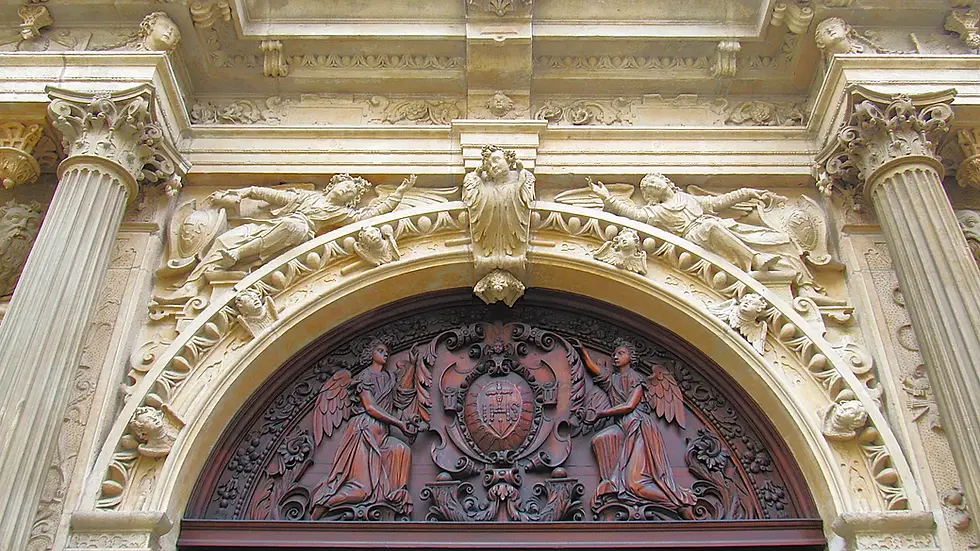
Key Historical and Structural Facts
Elevation: It was elevated to a cathedral in 1870 by Pope Pius IX when Luxembourg was established as a diocese.
Expansion: The cathedral was significantly enlarged between 1935 and 1938 by architect Hubert Schumacher, adding a transept, new choir, and two additional towers (east and central) to the original west tower.
Royal Crypt: The crypt houses the remains of several Grand Dukes and Grand Duchesses of Luxembourg, including Charlotte, Jean, and Marie-Adélaïde, as well as John of Bohemia (reinterred in 1945).
Patronage: It houses the statue of Our Lady of Consolation (Consolatrix Afflictorum), the patron saint of the city and nation, which has been venerated there since 1794.
Fire Damage: The west tower and bells were destroyed in a fire on Good Friday, 1985, during renovation work, and the tower was reconstructed by October of that year.


********************************
Echternach, Luxembourg - June 19, 2026
A Morning Adventure to Echternach

One of the unexpected pleasures of visiting Luxembourg is that public transportation is completely free. With buses and trains available at no charge, it becomes easy to embrace spontaneity. So when I woke early at 5 a.m., I decided to take advantage of the opportunity and set off on an adventure to Echternach, the oldest town in Luxembourg.
The journey was supposed to take about an hour by bus, though that estimate depended largely on whether the bus decided to run on schedule. As we made our way eastward through the countryside, the landscape gradually gave way to rolling hills and small villages before arriving in the historic town near the German border (30 minutes away by car).

Echternach is home to roughly 6,000 residents and possesses the kind of charm that can only be found in a small European town that has grown organically over centuries. The historic center serves as the heart of the community, where shops, cafés, churches, and the central bus station all converge within a remarkably walkable area. Life here moves at a slower pace, and the town feels refreshingly authentic. You can tell its center is focused on tourism because of the amount of restaurants and cafes in the area.


The history of Echternach stretches back to 698 when Saint Willibrord, an English monk from North Umbria, established an abbey on the site. His missionary work helped spread Christianity throughout the region, and his influence remains deeply woven into the town’s identity more than thirteen centuries later. The Basilica of Saint Willibrord, which houses his tomb, remains one of Luxembourg’s most important religious sites and holds the distinction of being the resting place of the country’s only saint.


What fascinated me most was how thoroughly the town’s history remains visible. The streets, buildings, and churches all seem connected to the abbey that gave birth to the community. During the Middle Ages, Echternach became an important center of learning and scholarship, with its abbey library and scriptorium gaining a reputation throughout Europe. Over the centuries the town endured fires, wars, revolutions, and occupations, yet it continually rebuilt itself while preserving its historic character.
Echternach is perhaps best known internationally for its famous Dancing Procession, held annually on Whit Tuesday in honor of Saint Willibrord. Pilgrims and participants move through the streets in a unique rhythmic procession that has become one of Luxembourg’s most distinctive religious traditions and is recognized by UNESCO as part of the world’s intangible cultural heritage.

The River Sauer flows quietly along the edge of town, forming the modern border between Luxembourg and Germany. Standing beside the river, it is easy to appreciate how borders can feel both significant and almost invisible. Today the crossing between the two countries is effortless, a reminder of how much Europe has changed over the centuries.

Like many places in Luxembourg, Echternach bears the scars of history. The town suffered damage during both World Wars, particularly during the Battle of the Bulge in the winter of 1944. Yet careful restoration has preserved much of its historical appearance, allowing visitors to experience a town that feels remarkably connected to its past.

My visit to Echternach ended up consuming the entire day, though not entirely by design. One of the reasons I lingered was to attend the free noon organ recital in the Basilica of Saint Willibrord. The performance was well worth the extra time. Sitting in the cool sanctuary while the organ’s powerful notes filled the ancient church was one of the highlights of my visit., especially the opening piece by J. S. Bach.
The real adventure began when it was time to return to Luxembourg City.
Buses from Echternach run only once an hour, so missing one is not a minor inconvenience. When my bus finally arrived, I climbed aboard without a second thought. What I failed to realize was that the bus changed its original number to another number and a totally different destination. Rather than heading toward Luxembourg City, it was now bound for a small town in the opposite direction.
Fortunately, I noticed the mistake after only one stop. Unfortunately, that still meant getting off, hiking back into town, and waiting another hour for the next bus.
Determined not to lose more time, I consulted my phone and discovered an alternative route on Mapquest. According to the map, another bus could get me back to Luxembourg if I made a transfer along the way. It seemed like a clever solution. I boarded the bus, feeling rather pleased with myself for outsmarting the transportation system; however, the bus gods had other ideas.
As I approached the transfer point, I watched in disbelief as the connecting bus failed to enter the designated bus loading area. Instead, it sailed right past on the adjacent road and disappeared into the distance before I could even wave. My carefully planned rescue operation evaporated in seconds. Another hour lost.

By this point, the afternoon heat had become oppressive, and I had learned an important lesson: never assume a bus will go where the schedule says it will go. When the next departure time approached, I stationed myself directly beside the roadway rather than in the shaded waiting area. If that bus intended to bypass the stop again, it was going to see me. An hour later, the bus appeared. And sure enough, it looked ready to repeat the exact same maneuver.
This time I was prepared. I stepped forward and waved my arms with enough enthusiasm to flag down a passing aircraft. The driver stopped, I climbed aboard, and after another hour-long ride I eventually made it back to Luxembourg City.
Looking back, the entire ordeal was more amusing than frustrating. Travel rarely goes exactly according to plan, and those are often the stories that become the most memorable. I may have spent several extra hours navigating Luxembourg’s bus network, but I also gained an unexpected adventure, a few miles of walking, lovely country scenery, and a story far more interesting than simply catching the correct bus home on the first try.Overall, Echternach left a lasting impression. It lacked the grandeur of Europe’s great capitals, yet offered something equally valuable: a sense of continuity. In a world that often feels hurried and constantly changing, Echternach seemed content to be itself—a small town shaped by faith, history, and tradition, quietly carrying more than thirteen centuries of stories within its streets.
********************************************

Bruges, Brussels - June 20-23, 2026 Costs $110 - Snuffel Youth Hostel - 3 nights, 4 bed dorm Euro to USD - 1.16 USD to 1 Euro (written in Euro when you see $) $9.11 - sandwich, 2 tarts, chocolate bar from grocery $5.50 - thrift store long sleeve shirt20.00 - 2 porcelain small bowls with butterflies $7.50 - laundry (wash and dry) $1.35 - chocolate croissant $10.05 - thrifting!… 6 white glass shell dishes, cravat, brown leather bracelet, small bone carved knife for cheese, one mother of pearl spoon with wooden handle $3.99 - grocery - pesto wrap Bruges: A Medieval City Frozen in Time
Bruges feels the most like stepping into a storybook. A short 15-minute walk from the train station, the town opens up onto cobbled stone streets. While the historic center is not car free, pedestrians and bicyclists reign supreme. It does feel a bit like Amsterdam.

Often called the “Venice of the North,” the city is famous for its network of canals, cobblestone streets, and remarkably preserved medieval architecture. While I understand the comparison, I couldn’t help but think that Strasbourg may actually have more canals. Still, there is no denying that water shapes the character of Bruges, winding through the city and reflecting centuries-old buildings that seem untouched by time.
One of my first surprises was linguistic rather than architectural. For some reason, I had assumed that French would be the dominant language. Instead, I quickly discovered that Bruges is firmly within the Flemish region of Belgium, where Dutch—and more specifically the West Flemish dialect—is the language most commonly spoken. It was a reminder that Belgium is far more culturally complex than many visitors realize.

The historic center of Bruges is a UNESCO World Heritage Site and among the best-preserved medieval cities in Europe. Walking through its streets, it was easy to understand why. Gothic churches, market squares, canals, and narrow lanes create an atmosphere that feels remarkably authentic rather than staged for tourists. Although millions of visitors arrive each year, Bruges somehow retains a sense of dignity and permanence. It is also squeaky clean.

The city’s prosperity began during the Middle Ages when it emerged as one of Europe’s great commercial centers. Strategically positioned between the markets of northern and southern Europe, Bruges became a hub for merchants, bankers, and traders. Goods from England, Scandinavia, Italy, and beyond passed through its markets. The city pioneered financial innovations, hosted what is often considered the world’s first stock exchange, and accumulated extraordinary wealth through international trade.


That prosperity attracted artists as well as merchants. During the fifteenth century, Bruges became a center of culture under the Dukes of Burgundy. Masters such as Jan van Eyck and Hans Memling helped establish the city as one of Europe’s artistic capitals. Their legacy remains visible throughout the city today.
Like many prosperous cities, Bruges eventually faced decline. The silting of the Zwin waterway gradually cut off its direct access to the sea, reducing its importance as a trading center. Commercial activity shifted elsewhere, particularly to Antwerp, and Bruges entered a long period of economic stagnation. Ironically, that decline helped preserve the city. Because relatively little modernization occurred, much of its medieval fabric survived intact.


By the nineteenth century, visitors began arriving not for commerce but to admire the city’s historic beauty. What had once been viewed as a relic of the past became one of Europe’s most treasured destinations. Today, visitors come from around the world to experience the same streets, canals, churches, and market squares that have defined Bruges for centuries. Come on a Saturday, or when the cruise ships bring throngs on tourists, you feel like you are walking the packed streets of Venice. Every breathes a sigh of relief for Sunday and Monday, when things return to normal and a lot less hectic. Staying here for several days, I too could witness the pulse change, and I was delighted for the slower pace and quiet.


As I wandered through the city, I found myself repeatedly looking upward. The soaring Belfry dominates the skyline, while the Church of Our Lady rises above the rooftops with one of the tallest brick towers in the world. Around every corner seemed to be another view worthy of a postcard.
What impressed me most, however, was not any single monument. It was the remarkable sense of continuity. Bruges does not feel like a city that merely preserves history; it feels like a city still living within it. The canals still flow, the bells still ring, and daily life continues amid buildings that have witnessed hundreds of years of European history.
In a continent filled with beautiful cities, Bruges stands apart because it feels timeless. It is not difficult to imagine merchants, pilgrims, artists, and travelers from centuries past walking the same streets. It is a treasure. *************************************** St. James’s Church is a Catholic church in Bruges, Belgium. Originally built around 1240, the church was considerably expanded in 1459 to match the rising affluence of Bruges, and was patronized by the Duke of Burgundy. In the late 17th and early 18th centuries, the church’s interior was remodeled in its present Baroque style.
Because it’s hot and many houses do not have AC, the church has opened a study area in the sanctuary for university students to review their courses before exams next week. The church inside is refreshingly cooler than outside.


*************************************** Church of the Bruges Camelites
In the seventeenth century, Bruges was home to at least twenty abbeys and convents, and even today more than a quarter of the historic city center remains connected to religious life. Only two monastic communities continue their presence in the city: the English Convent and the Discalced Carmelites Convent. Both welcome visitors who wish to experience authentic monastic life and explore their spiritual heritage.

The story of the Discalced Carmelites in Bruges began in the seventeenth century, although the origins of the Carmelite Order reach much further back. In the twelfth century, a group of hermits settled on Mount Carmel in present-day northern Israel and gradually formed a religious community. Around 1210, they received an official rule of life from the Patriarch of Jerusalem. As Islamic rule expanded throughout the region, the Carmelites dispersed across Europe, arriving in Bruges by the middle of the thirteenth century.


A major reform of the order emerged in sixteenth-century Spain through the efforts of Teresa of Ávila and John of the Cross. Their stricter observance became known as the Discalced Carmelites, a name derived from their practice of going barefoot or wearing simple sandals as a sign of poverty and humility. The Discalced Carmelites established themselves in Bruges in 1630, first on Schaarstraat and later in the noble residence known as the Hof van Uytkerke on Ezelstraat.
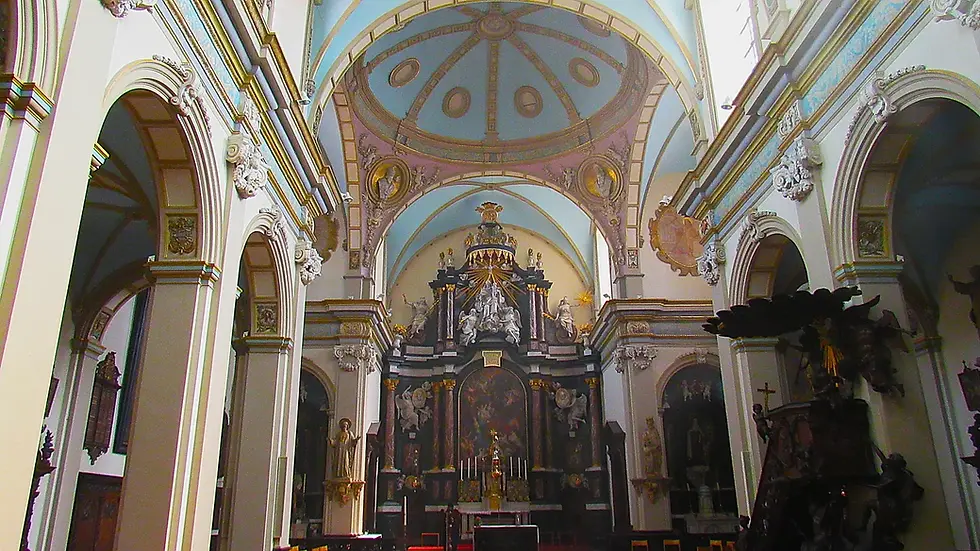
Originally constructed in the fifteenth century, the Hof van Uytkerke was transformed into a monastic complex containing a church, refectory, dormitory, and extensive garden. Between 1688 and 1691, the community rebuilt the church according to plans drawn by Brother Patricius of Antwerp. Its façade bears a striking resemblance to that of St. Augustine’s Church. During this same period, the monastery library was constructed. Throughout the eighteenth century the community flourished, reaching more than forty members by 1773. Additional buildings, including a simple refectory overlooking the garden, further altered the appearance of the complex.

The upheavals of the French Revolution brought an end to many religious communities throughout Europe. While the nearby Shoed Carmelites of Carmersstraat disappeared, the Discalced Carmelites survived. Although the property was confiscated and sold, the Prior of Ghent eventually succeeded in repurchasing it and restoring monastic life.
The convent’s architecture is notably restrained and austere, reflecting Carmelite ideals. In contrast, the church interior is richly decorated in the Baroque style. Religious art served not only as decoration but also as a means of teaching the faith. Much of the interior ornamentation was created by Brother Victor, born Jacob de Coster, whose craftsmanship can be seen throughout the church. His work includes the high altar, pulpit, communion rail, interior doors, and elegant wooden paneling.

Among the church’s treasures, the high altar stands out as a masterpiece. Although carved from wood, it is painted to imitate marble with remarkable realism. The altar painting was presented by the city of Bruges in gratitude for the Carmelites’ service during a devastating plague epidemic. The monks had earned the affection and respect of the city’s residents by caring for the sick when many others would not. Their dedication came at a tremendous cost, as nine brothers and priests lost their lives while ministering to plague victims.
Today, the Church and Convent of the Discalced Carmelites remains one of Bruges’ most significant religious complexes, encompassing the church, convent buildings, and a secluded walled garden. The seventeenth-century adaptations of the Hof van Uytkerke remain visible throughout the site, illustrating centuries of monastic life and architectural evolution. Recognition of its cultural importance led to partial protected status in 1974, with additional protection granted in 1984 to the church interior, its vaults, and the historic plague house. Together, these preserved spaces offer a remarkable glimpse into the spiritual, artistic, and charitable legacy of the Carmelites in Bruges. **************************************

Brussels, Belgium June 23 - 29, 2026 Costs: Euro to USD - 1.16 USD to 1 Euro (written in Euro when you see $) $18 - train from Bruges to Brussels$3.70 - grocery - 2 packs of cookies $10 - handmade calfskin square bag from thrift store $11.60 - subway to airport $1,500 - Pillows City Hotel Brussels: More Than a Capital
Brussels is Belgium’s largest city and its political heart, serving not only as the nation’s capital but also as the de facto capital of the European Union and the headquarters of NATO. Home to more than 1.2 million residents, the city sits at the crossroads of Germanic and Romance Europe, creating a vibrant blend of cultures unlike anywhere else on the continent.

Despite its international importance, I have to admit that I preferred Bruges. Brussels certainly has its own charm, but where Bruges feels intimate and timeless, Brussels is larger, busier, and unmistakably cosmopolitan.
One of the first things I noticed was the city’s bilingual nature. Every street sign appears in both French and Dutch, often with names so different that they seem unrelated. Although Brussels is officially bilingual, French clearly dominates daily life. English is also widely understood, thanks to the thousands of diplomats, civil servants, and international workers who call the city home. Walking through the streets, I frequently heard conversations shifting effortlessly between multiple languages, reflecting Brussels’ role as one of Europe’s most international cities.

Historically, Brussels began as a small settlement founded in the late tenth century before growing into an important commercial center. When Belgium became an independent nation in the nineteenth century, the city underwent dramatic transformation. Large sections of the medieval town gave way to ministries, government buildings, schools, and grand boulevards as Brussels evolved into the nation’s political capital. While remnants of the old city remain—most notably the magnificent Grand Place—other Flemish cities such as Bruges, Ghent, and Antwerp retain a more complete medieval character.
***************************************************************
The Cathedral of St. Michael and St. Gudula (Dutch: Sint-Michiels- en Sint-Goedelekathedraal) is the primary Gothic cathedral in Brussels, Belgium, serving as the co-cathedral of the Archdiocese of Mechelen–Brussels. Although historically known as the Collegiate Church of St. Michael and St. Gudula, it was officially designated a cathedral in 1962.

The church stands on the Treurenberg hill, a historic crossroads, with origins dating back to a 9th-century chapel dedicated to Saint Michael the Archangel. In 1047, the relics of Saint Gudula were transferred to the site, adding her as a co-patron saint. The current structure, built primarily in the Brabantine Gothic style, was constructed between the 13th and 15th centuries and is renowned for its imposing towers and royal ceremonies, including the 1999 wedding of Crown Prince Philippe.


*********************************
The Église du couvent des Pères Carmes de Bruxelles (Church of the Convent of the Discalced Carmelite Fathers) is a Roman Catholic church located at 44-45 Avenue de la Toison d’Or, 1050 Ixelles, Belgium.

It is built in the Lombard Neo-Gothic style, characterized by a tripartite facade with small arcades and brickwork. The current structure was built between 1861 and 1875 by architects Menge, Appelmans, and Cuypens, replacing an earlier 17th-century church destroyed in 1796. The church is dedicated to Saint Joseph and Saint Thérèse of Ávila, whose sculptures adorn the facade. It houses a historic organ originally designed by Merklin-Schütze (1869) and renovated by Roethinger and Patrick Collon.

********************************************
Église Notre-Dame du Sablon (Church of Our Lady of Victories) is the most prominent, located in the upscale Sablon district. Built in the 15th century in the late Brabantine Gothic style, it originated as a chapel for the Crossbowmen’s Guild. The church is renowned for its flamboyant Gothic exterior, tall stained-glass windows, and two Baroque chapels.

It is a prime example of Late Brabantine Gothic architecture, with construction beginning around 1400 and completing in 1549. The church features rich Baroque interior elements, including two chapels built by the Thurn und Taxis family in the 17th century. Originally built for the Guild of the Crossbowmen, the church gained fame due to a miraculous statue of the Virgin Mary transported from Antwerp in 1348. This event initiated the Ommegang, a major historical procession in Brussels. The church was designated a historic monument in 1936. Its current ornate exterior, including turrets and pinnacles, results from major 19th-century restorations led by architects Jules-Jacques Van Ysendyck and his son, who restored the structure to a unified Gothic style.

Notable Features: The interior houses a 1697 Baroque pulpit by Marc de Vos, polychrome murals from the 15th century, and over 300 stained-glass windows. The church is situated near the Place du Grand Sablon and serves as the burial site for figures such as Marie of Hungary. ************************************************************ The Chapel of Marie-la-Misérable (also known as Lenneke Marekapel) is a 14th-century Brabantine Gothic religious site located at 37 Avenue de la Chapelle in Woluwe-Saint-Lambert, a commune of Brussels, Belgium.

The chapel commemorates Marie, a 14th-century recluse who was falsely accused of theft by a spurned nobleman. She was sentenced to be buried alive, and miracles at her execution site led to the chapel’s construction as a pilgrimage shrine. Built in the Gothic Brabantine style, the interior features a 17th-century Baroque ensemble (sanctuary, balustrade, and pulpit) and a notable 1609 triptyque attributed to David Teniers the Elder, depicting scenes from Marie’s life. Since 1922, the chapel has been managed by the Assumptionist Fathers and is classified as a heritage site.

************************************************
My reason for coming to Brussels, however, had little to do with politics or architecture. I was here to attend Various Voices, Europe’s largest LGBTQIA+ choral festival. Held every four years under the auspices of LEGATO, the European association of LGBTQIA+ choirs, the festival brings together singers from across Europe and beyond in a week-long celebration of music, community, and inclusion. This was my third Various Voices festival, having previously attended the gatherings in Bologna and Munich.

Choirs arrived from nearly every corner of Europe, joined by ensembles from North America and even Iceland. Throughout the city, singers filled concert halls, churches, theaters, and public squares. Music spilled into the streets, transforming Brussels into more than just a political capital; it became a place where thousands of LGBTQIA+ people gathered to celebrate identity, friendship, and the universal language of song.
For me, Brussels was not simply another destination on my itinerary. It was a reunion with friends, an opportunity to meet new people from around the world, and a reminder of how music has the power to build community across languages, cultures, and national borders. The city’s diversity made it the perfect host for a festival dedicated to bringing so many different voices together.

One of the highlights of my time in Brussels was visiting the House of European History. Housed in the beautifully restored Eastman Building within leafy Parc Léopold, the museum explores the story of Europe—not through the history of individual nations, but by examining the shared experiences that have shaped the continent. Every exhibit is available in all twenty-four official languages of the European Union, making the museum itself a fitting symbol of European cooperation.

I arrived when the doors opened at 9:00 a.m., convinced I would have ample time to see everything before lunch. I was wrong. By noon, I had not even finished the permanent exhibition, let alone begun the temporary exhibition. The museum was so thoughtfully organized and intellectually engaging that I found myself lingering at nearly every display. Rather than rushing from one artifact to the next, I wanted to read the explanations, watch the multimedia presentations, and reflect on how each era connected to the next.
The exhibition begins with the ancient myth of Europa before guiding visitors through the rise and fall of empires, the Enlightenment, industrialization, nationalism, colonialism, the devastation of two world wars, the Holocaust, the Cold War, and ultimately the creation of the European Union. Rather than presenting history as a series of isolated national stories, the museum weaves them together into a single narrative, demonstrating how the fortunes of one country have always been intertwined with those of its neighbors.

What impressed me most was the museum’s willingness to confront difficult subjects. It does not shy away from Europe’s colonial past, the horrors of fascism and communism, genocide, or the divisions that have repeatedly fractured the continent. At the same time, it celebrates the remarkable achievements that emerged from those tragedies, particularly the determination to pursue cooperation instead of conflict after the Second World War.
The final galleries are especially thought-provoking. Rather than ending with a triumphant celebration of European integration, they ask visitors to consider the future of Europe. Questions about democracy, migration, climate change, identity, and the role of the European Union are presented without easy answers, encouraging visitors to think critically about where the continent is headed.

Perhaps the greatest compliment I can give the House of European History is that I never once looked at my watch. Hours passed without my noticing. Admission is free, yet the museum rivals many of the world’s finest history museums in both scholarship and presentation. I eventually left knowing I had not seen everything, but I also left with a far deeper appreciation for the complex, often turbulent, history that has shaped modern Europe.
If I ever return to Brussels, this will be one of my stops. There is simply too much to absorb in a single visit. *****************************************************************************

No visit to Brussels would be complete without spending time in the Grand-Place, or Grote Markt, the city’s magnificent central square. Often described as one of the most beautiful public squares in the world, it more than lives up to its reputation.

Originally established as a marketplace in the eleventh century, the square has witnessed nearly a thousand years of commerce, celebrations, political upheaval, and everyday life. Much of what visitors see today dates from the remarkable rebuilding that followed the devastating French bombardment of 1695. Within just a few years, the city’s guilds transformed the ruins into the spectacular ensemble of Baroque architecture that surrounds the square today.
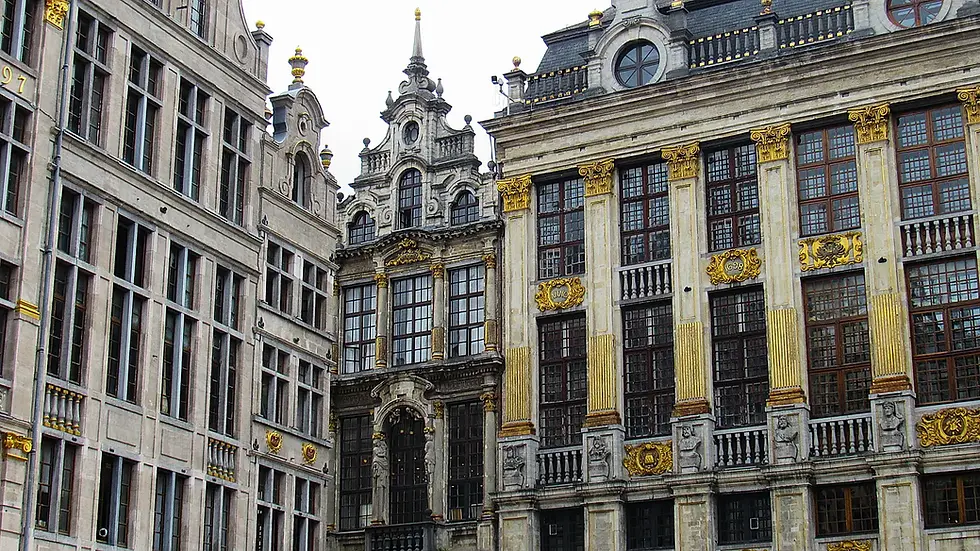
The ornate guildhalls compete for attention with the soaring Gothic Town Hall, whose elegant spire dominates the skyline. Across the square stands the King’s House (Maison du Roi), a striking neo-Gothic building that now houses the Brussels City Museum. Although each façade is unique, together they create an architectural harmony that is breathtaking from every angle.

I found myself slowing my pace as I entered the square. The surrounding streets suddenly opened into an expansive space paved with centuries-old cobblestones, and I instinctively stopped to take it all in. Every building seemed covered with intricate carvings, gilded details, statues, and ornamentation that rewarded a closer look. No matter where I turned, there was another façade demanding my attention.

Unlike many historic squares that function primarily as tourist attractions, the Grand-Place still feels like the living heart of Brussels. Residents and visitors alike gather at cafés, linger on the steps, admire the architecture, or simply pause to absorb the atmosphere. It is easy to understand why UNESCO designated the square a World Heritage Site and why it continues to be regarded as one of Europe’s greatest public spaces.
Some places impress because of a single iconic monument. The Grand-Place is different. Its beauty comes from the harmony of the whole. Standing there, surrounded by centuries of history and extraordinary craftsmanship, I understood why so many people consider it the crown jewel of Brussels. **************************************************************

Brussels is a city in constant transition. Once a modest settlement along the River Senne, it has grown into Belgium’s largest metropolitan region and the de facto capital of the European Union. The transformation has been dramatic over the past two centuries, driven first by industrialization and more recently by globalization and immigration. Today, more than 1.2 million people call the Brussels-Capital Region home, while the metropolitan area exceeds 2.5 million residents.
What fascinated me most was not the statistics but the city’s remarkable diversity. As I wandered from one neighborhood to another, I could sense Brussels continually reinventing itself. Different districts reflected the cultures of more recent arrivals, each adding another layer to the city’s identity. Conversations shifted effortlessly between languages. Bakeries, cafés, restaurants, grocery stores, and markets showcased cuisines from every corner of the globe. Traditional European architecture stood alongside mosques, African hair salons, Asian supermarkets, Middle Eastern bakeries, and businesses serving communities from around the world.

Brussels has often been described as a multicultural city, but that term almost seems too limited. The city feels more like a crossroads where cultures do not simply coexist but interact, influence one another, and continually reshape the urban landscape. Walking its streets, I was reminded that European history is still being written, not only through treaties and politics but through the everyday lives of the people who now call Brussels home.


That evolution is visible beyond the people themselves. Murals and street art brighten neighborhood walls, often addressing themes of identity, migration, equality, and social justice. Even the graffiti seemed less like random vandalism and more like an ongoing conversation about the city’s changing character. Brussels wears its transformation openly, allowing visitors to witness a city that is continually negotiating its past while embracing an increasingly diverse future.
Some visitors come to Brussels for its politics, others for its architecture or museums. I left remembering something different. I remembered a city alive with many languages, many traditions, and many stories—a place that reflects not only Belgium, but the increasingly interconnected world of the twenty-first century. Brussels challenged many of my expectations. I arrived anticipating a city defined primarily by politics—a place of bureaucrats, diplomats, and the institutions of the European Union. Those elements are certainly present, but they are only one part of a much richer story.

Over the course of my visit, I discovered a city where history and modernity exist side by side. Medieval guildhalls stand only blocks away from sleek government buildings. World-class museums encourage visitors to examine Europe’s triumphs and tragedies with honesty and humility. Neighborhoods echo with dozens of languages, while cafés and markets celebrate cultures from every continent. It is impossible to walk through Brussels without recognizing that Europe continues to evolve.
Attending Various Voices added another dimension to my experience. Thousands of LGBTQIA+ singers from across Europe and beyond gathered not only to perform, but to celebrate community, diversity, and belonging. In many ways, the festival mirrored the city itself: people from different backgrounds, languages, and traditions coming together to create something more beautiful than any one group could achieve alone.

Brussels may never become my favorite Belgian city—that honor still belongs to Bruges—but it is undoubtedly one of the most fascinating. It is a city of contrasts, where old and new, local and international, tradition and change constantly intersect. More than any other place I visited, Brussels reminded me that Europe is not a finished story. It is a living project, continually shaped by its history, its people, and its willingness to imagine a shared future.
As my subway car pulled away from the station and into the airport in the early hours of June 29, I realized that I was leaving with more than photographs and souvenirs. I carried with me a deeper appreciation for the complexity of Europe and the extraordinary diversity that gives the continent its enduring strength. Brussels had shown me that the true heart of Europe is found not only in its institutions, but in the countless voices, cultures, and histories that continue to shape it every day.


Comments